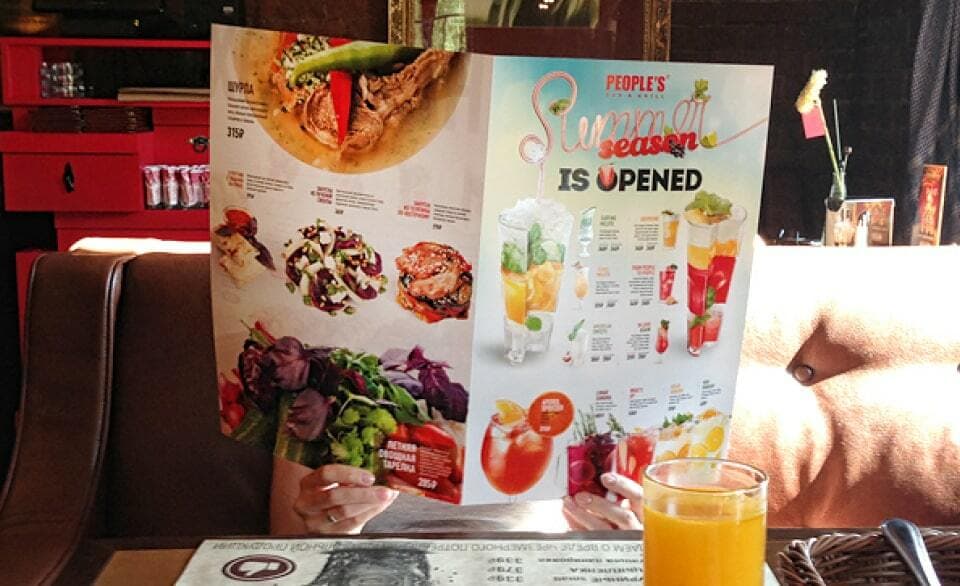
"How often should we change the menu" is almost never a culinary question. In practice it comes down to arithmetic: what does one change cost, and how many times a year can you afford it.
A restaurant that prints its menu changes it once or twice a year, because every change means design, printing and laminating. A restaurant with a digital menu changes it when the delivery changes. Same culinary decision — different cost threshold.
This article covers both sides: when a seasonal change genuinely pays off, and how to set up the process so it doesn't cost you a week of work every time.
Why seasonality pays off financially
In-season produce is cheaper and better
Tomatoes in August and tomatoes in February are two different products, and the wholesale price gap runs to 3–4×. A dish built on what is actually in the market has a lower food cost at the same menu price — and often better quality, because the produce didn't travel across a continent.
This works both ways. In winter, root vegetables, cabbage, pickles and game are cheap and good. In summer, tomatoes, courgettes, berries and herbs. A menu that ignores this pays the out-of-season price and sells at the same margin as at peak.
A change gives you something to talk about
A new menu is a natural reason to post, send a newsletter and invite regulars back. A restaurant that never changes anything has nothing to say — and social algorithms punish silence.
Seasonality forces you to prune
Every change makes you review the list and see what isn't selling. A menu nobody touches for three years bloats: nothing gets removed because "someone orders it occasionally". The kitchen carries stock for ten items that move once a week.
How many times a year — three realistic models
| Model | Frequency | Who it suits | Condition |
|---|---|---|---|
| Four seasons | 4 × year | seasonal kitchens, fine dining | the menu has to be cheap to change |
| Two seasons | 2 × year (spring/summer, autumn/winter) | most restaurants and bars | safest place to start |
| Fixed menu + insert | menu 1 × year, insert monthly | pizzerias, venues with strong classics | the insert must not look like an office printout |
A fourth model — changing the lunch offer daily — is a separate discipline; with printed menus it is practically impossible without a chalkboard.
What to calculate before you change the menu
Before choosing a model, work out the cost of a single change. For a printed menu that is usually:
- designer time for the layout — from €50 for small corrections to €350 for a new design,
- printing 30–60 copies — €70 to €280 depending on format, paper and finish,
- lamination or binding — €1–4 per copy,
- your own time: collecting changes, proofreading, collecting from the printer — realistically 4–8 hours.
At two changes a year that is a few hundred euros; at four, double. More importantly, this number decides your frequency. If one change costs €500, you will not do it four times a year no matter how much the kitchen wants to.
Run the numbers for your own venue in our savings calculator.
The process in five steps
1. Analyse what you already have (2–3 weeks before)
Pull item-by-item sales for the last six months. You are looking for four groups: sells well with good margin (stays, and moves to a prominent spot), sells well with poor margin (fix the recipe or the price), sells poorly with good margin (fix the description and the position), sells poorly with poor margin (goes).
2. Proposals from the kitchen
The head chef proposes 8–12 items for the coming season. No costing at this stage — this is about ideas.
3. Costing and tasting
Every new dish gets a cost sheet: portion weight, ingredient cost, food cost, menu price. Only then a tasting with the floor team — they will be the ones recommending it, so they need to know how it tastes.
4. Descriptions, photos, allergens
New items need a description and allergen labelling — that is an obligation, not an extra. Take the photos during the tasting, by a window, on a phone; it is the only moment when every dish is plated at once.
5. Publishing and briefing the floor
The menu goes to print or to the panel, and the team gets a short briefing: what's gone, what's new, what to recommend and with what. Nothing is worse than a waiter who doesn't know what's in the new dish.
Five mistakes that ruin a menu change
- Replacing the whole menu at once. Regulars come for their dish. Change 30–40% of the items, not 100%.
- No end dates. An "autumn offer" with no expiry stays on the website until March.
- Changing the menu in the venue but not online. A new menu on the table and the old one on the website and in Google is a guaranteed disappointment.
- New dishes with no costing. A seasonal dish nobody calculated can easily run a 55% food cost.
- Forgetting allergens. A new recipe means a new allergen list. The information duty applies from day one, not from the moment someone asks.
What this looks like when the menu is digital
A seasonal change on an online menu is a different operation: you switch off what's leaving, add what's new, change photos and prices — and it is live the same minute, on the website, in the Google profile and behind the QR code on the table. No printing, no waiting for the print shop, no stack of obsolete menus to throw away.
The practical difference isn't the paper saved. It is that the threshold for changing drops to zero. A dish that isn't moving gets switched off on a Wednesday instead of waiting 5 months for the next print run. A seasonal item goes up the day the first delivery arrives.
In WMenu items can be hidden rather than deleted — the season ends, the dish disappears from the guest's menu, and comes back next year with one click, together with its description, photo and allergens. See how a QR menu works or browse menus from real venues.
Frequently asked questions
How often should I change the menu if I'm just starting?
Twice a year. That is enough to follow the seasons and little enough not to disrupt the kitchen. More often makes sense once changing stops costing money.
Won't changing the menu scare off regulars?
Replacing everything at once will. Keep the classics that sell and change around them. If you are removing something popular, announce it — "last week on the menu" works as a promotion too.
What do I do with a dish that sells poorly but has a great margin?
First fix the description and move it somewhere visible on the menu. Only if it still isn't moving after a month should it go.
Do I have to reprint the menu every time a price changes?
With a printed menu, yes — and that is exactly the cost that decides your frequency. With a digital menu the price changes in the panel and applies everywhere immediately.