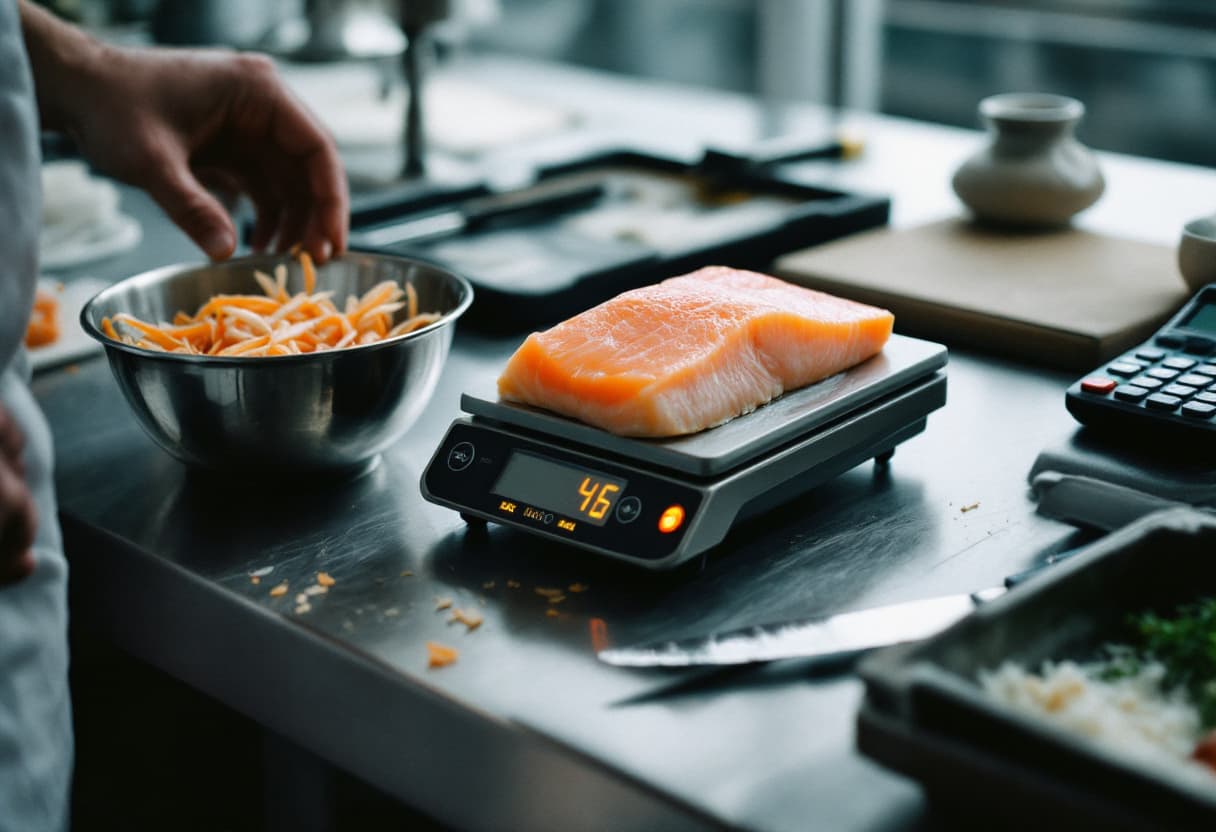
Food cost percentage is the cost of the ingredients in one portion divided by the menu price without VAT, times 100. A fish and chips that uses €4.74 of ingredients and sells for €16 including 10% VAT runs at 32.6%. Getting the €4.74 right is most of the job, and that is where the usual errors hide: a fillet costed at its trimmed weight, frying oil left off the card, a portion that grew by 30 g over the summer.
Below, one recipe card is built from scratch and turned into a price. The same dish is preloaded in the free food cost calculator, so you can follow along and swap in the prices from your own invoices.
The formula, and which price goes under the line
Food cost % = ingredient cost per portion ÷ net menu price × 100
Net means without VAT. The VAT on the bill belongs to the tax office, not to the kitchen. Divide by the price printed on the menu and the result looks better than it is: €4.74 ÷ €16.00 gives 29.6%, apparently on target. €4.74 ÷ €14.55 gives 32.6%. That second figure is the real one.
In the UK the same number is discussed from the other side, as gross profit or GP. A 70% food GP is a 30% food cost, and both are worked out on the ex-VAT price. How much of that GP survives wages, rent, energy and the rest of the overheads is worked through on a full four-week P&L in restaurant profit margin.
Everything here is theoretical food cost: what a dish should cost according to its recipe. Actual food cost comes from the stock count — opening stock plus purchases minus closing stock, divided by food sales for the period. You need the first to set prices. The second tells you whether the kitchen follows the recipe, and a gap of more than two or three points between them points to waste, heavy portions or stock leaving unrecorded.
What goes on a recipe card
A recipe card, also called a recipe costing sheet or standard recipe, does two jobs: it makes the dish the same way every time, and it says what the dish costs. For the costing half, each ingredient needs three figures:
- net quantity — what ends up on the plate, in g, ml or pieces;
- purchase price — per kg, litre or piece, from the invoice, without VAT;
- yield — the usable share of what you buy after peeling, trimming, boning or cooking.
For the dish as a whole you add the number of portions one batch makes.
Yield is the column most cards skip. A side of salmon with skin may give 70% usable portions once it is skinned, pin-boned and trimmed. Every 150 g portion then means buying 214 g, and the invoice charges for 214.
Quantity to buy = net quantity ÷ yield
Published tables give a starting point. Francis Lynch's The Book of Yields is the reference used in many culinary schools, and the commonly quoted ranges are 40–50% for whole round fish to fillet, 75–85% for peeled potatoes and around 50% for octopus after boiling. Your supplier's cut and your chef's knife decide the real figure, though. Run your own yield test on the five most expensive ingredients: weigh as delivered, after trimming and after cooking, three times, and take the average.
Worked example: fish and chips
Prices are illustrative wholesale prices without VAT. Replace them with your own.
| Ingredient | Net per portion | Yield | Bought | Price | Cost |
|---|---|---|---|---|---|
| Cod fillet | 180 g | 85% | 212 g | €18.00/kg | €3.81 |
| Potatoes | 300 g | 75% | 400 g | €1.20/kg | €0.48 |
| Flour for the batter | 60 g | 100% | 60 g | €1.00/kg | €0.06 |
| Frying oil | 50 ml | 100% | 50 ml | €3.00/l | €0.15 |
| Peas | 80 g | 100% | 80 g | €3.00/kg | €0.24 |
| Portion | €4.74 |
At €16.00 on the menu with 10% VAT, the net price is €14.55 and food cost is 32.6%. After ingredients, €9.80 per portion is left for wages, rent, energy and profit.
Drop the yield column and the same card adds up to €4.05, or 27.8%. Five points of food cost, 69 cents a plate. The spreadsheet does not see them; the supplier's invoice does.
What food cost percentage to aim for
No single figure is right, and the ranges published by POS vendors, consultancies and trade bodies disagree by five points or more. These are the ones cited most often:
| Venue type | Commonly cited food cost |
|---|---|
| Café, coffee-led | 15–25% |
| Pizzeria | 20–30% |
| Quick service, street food | 25–32% |
| Full-service restaurant | 28–35% |
| Fine dining | 30–40% |
Each range quietly assumes a level of labour. The ceiling usually quoted for prime cost, food plus labour, is 60–65% of sales. A pasta bar that rolls everything by hand pays more in wages and needs a lower food cost to stay under that line. A counter-service place with two staff can spend 35% on ingredients and still be fine.
Set targets per category rather than one number for the whole menu: desserts and coffee carry low percentages, steak and seafood high ones. And judge a dish by the cash it leaves as well as by its percentage. A carbonara at 22% leaves about €9 a plate; a ribeye at 38% on a €34 price leaves around €19. Which of the two deserves the better spot on the page is a question for menu engineering, which weighs that margin against how often each dish sells.
From food cost to menu price
Net price = cost per portion ÷ target food cost
For the fish and chips at a 30% target: €4.74 ÷ 0.30 = €15.81 net, €17.39 with 10% VAT.
The multiplier many kitchens use is the same sum turned around: ×3 is a 33% food cost, ×3.33 is 30%, ×4 is 25%. Apply it to the net cost to get a net price, then add VAT. A kitchen that treats cost × 3.33 as the price printed on the menu is really running at 33% with 10% VAT, not 30%.
A flat multiplier has a worse flaw. It overprices expensive proteins and underprices cheap dishes. A steak with €12 of meat at ×3.33 becomes €40 net and €44 on the menu, which is where a casual restaurant stops selling it. Most menus run expensive mains at a lower multiple and recover the difference on soups, pasta and desserts.
Then round. €17.39 does not have to stay €17.39; €17.50 or €17.90 reads better, and the piece on menu price psychology covers which endings make any difference. One case where the formula does not lead: dishes whose price the market has already fixed, such as an espresso, a pint or a set lunch at a known price point. There you start from the price and work back to the portion and ingredients you can afford. Checking a price against the market and passing a wage rise into prices is the subject of menu pricing, and the labour half of the sum is prime cost.
VAT: cost without it, price with it
Every figure on the card is without VAT, from the invoice prices to the target, and VAT is added once, at the end, to print the menu price. The order matters because restaurant food is taxed differently across Europe:
| Country | VAT on food served in a restaurant |
|---|---|
| Germany | 7% since 1 January 2026 (drinks 19%) |
| Ireland, Netherlands | 9% (Ireland since 1 July 2026) |
| Spain, France, Italy, Austria | 10% |
| Belgium | 12% |
| Portugal | 13% (most drinks 23%) |
Rates as of October 2026. Alcohol and takeaway often have their own rate, so confirm yours with your accountant. The same fish and chips at €16 on the menu runs at 31.7% in Germany and 33.5% in Portugal: identical price, identical ingredients, different net.
The card's purchase prices are net only if you reclaim input VAT. A business outside the VAT system pays the gross invoice price and keeps the whole menu price, so it costs at gross prices and divides by the full price.
When supplier prices change
A recipe card is right on the day it was costed. If cod goes from €18 to €21 a kilo, the fish line rises from €3.81 to €4.45 and the dish moves from 32.6% to 37.0% without anyone changing the recipe.
A workable rule is to re-cost a dish when an ingredient that makes up more than 10% of its cost moves by more than 5%, and to review the whole menu every quarter and at every menu change. Cod is 80% of this plate's cost, so every cod invoice that moves is a reason to look. Flour can double and nothing happens.
Adjusting the price afterwards should be cheap, and with a printed menu it is not: every change is a reprint, so prices freeze for a year. What a restaurant menu really costs puts numbers on that. On a digital menu the new price is live the same day.
Mistakes that make a recipe card lie
Costing the trimmed weight. In the example it hides 69 cents a portion. The error is largest on whole fish, meat on the bone and anything that loses water in the pan.
Leaving out the small stuff. Salt, pepper, frying oil, the lemon wedge, tartare sauce, bread, the herb garnish. Each one rounds to zero; together they do not. Add €0.35 for lemon, tartare and seasoning to the fish and chips and it goes from 32.6% to 35.0%. Some costing textbooks cover this with a fixed allowance of a few percent on top of the card, called the Q factor. Listing the items as lines is more accurate when you can.
Portion drift. Popular dishes get generous: a bigger scoop, an extra handful of chips. A portion 10% heavier across the board takes the fish and chips from 32.6% to 35.9%. A scale on the pass and a photo of the plated portion on the card cost less than the drift. Portion specs, scoop sizes and a weekly spot check are in portion control.
Counting planned portions on batch dishes. A 10-litre pot of soup is not 25 portions of 400 ml if a litre stays in the pot and on the ladle. Cost the batch, then divide by what you actually serve.
Old prices. A card costed with last spring's invoice is not a card, it is a memory. Date every price.
Spreadsheet or tool
A spreadsheet is enough while you have up to about 20–30 recipes, one person keeps them and suppliers change prices a few times a year. It breaks when the same ingredient sits in many recipes. If butter appears on 12 of 40 cards, each new butter price is 12 edits, and one always gets missed. Sub-recipes make it worse: a demi-glace used in 6 dishes has to be costed first and then carried into each of them.
That is when an ingredient library pays for itself: one price per ingredient, recipes that point to it, and one change that recosts every dish. In the WMenu panel this is part of the Standard plan, €29 a month (see pricing). Ingredients are a single list, purchase invoices are read from a photo, a sauce can be a sub-recipe inside other dishes, and the price at your target food cost goes onto the menu with one click. For a single dish, the food cost calculator works without an account.
Neither replaces a stock count. Theoretical cost says what a dish should cost; only inventory says what the kitchen used.
Frequently asked questions
Is food cost calculated on the price with or without VAT?
Without. Divide by the net price, which is the menu price divided by 1 plus the VAT rate. Purchase prices on the card are net too, as long as you reclaim input VAT.
What is the difference between food cost and GP?
They add up to 100%. A 30% food cost is a 70% gross profit. GP covers only ingredients, so a dish with a healthy GP can still lose money once labour and rent are counted.
How do I cost a soup, stew or sauce made in batches?
Cost the whole batch as one recipe, measure the finished quantity and divide by the portions you actually serve from it. If the sauce goes into several dishes, give it its own cost per litre and use it as an ingredient.
Should drinks have the same target as food?
No. Commonly cited pour-cost targets for spirits are around 18–24%, well below food, and in Germany, France and Portugal drinks also carry a different VAT rate from food. Cost them on separate cards.