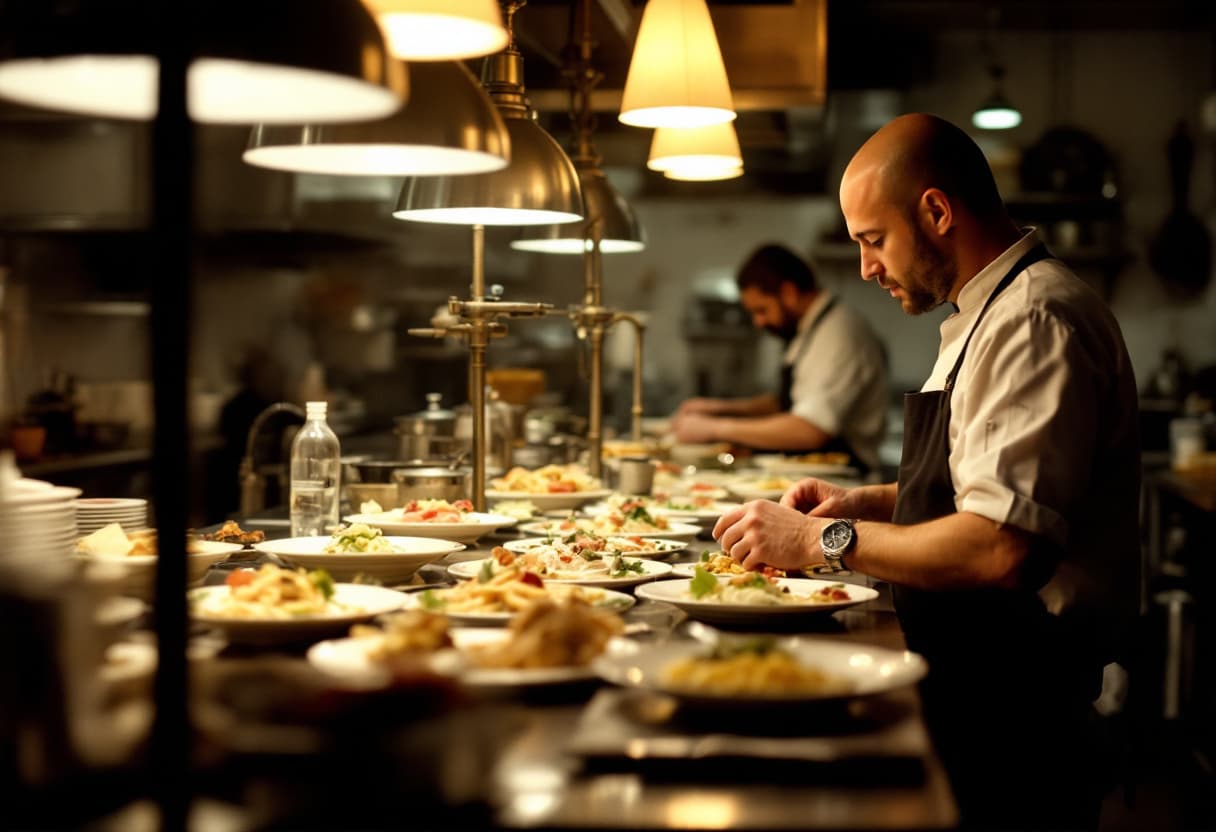
Prime cost is what a restaurant spends on food and drink plus everything it spends on staff, as a share of net sales. A bistro that sold €62,000 in four weeks, used €19,600 of stock and paid €20,000 in total labour ran a prime cost of 63.9%. The remaining 36.1%, €22,400, has to pay the rent, energy, card fees, repairs and the profit.
It is the most useful single number in a restaurant P&L because the two costs trade against each other. Buy peeled potatoes and food cost rises while prep hours fall. Make your own stock and the opposite happens. Food cost alone cannot tell you whether the swap was worth it; prime cost can. How to cost one dish is covered in how to calculate food cost per dish, and the free food cost calculator does the per-plate sum.
The formula
Prime cost % = (cost of goods sold + total labour cost) ÷ net sales × 100
Each of the three parts has a trap.
Cost of goods sold is the actual figure from a stock count, not the theoretical cost from recipe cards: opening stock plus purchases minus closing stock. Purchases alone swing with delivery days. A big order on the last day of the period inflates one month and flatters the next.
Total labour is more than wages. It includes salaried staff and managers, employer social contributions, holiday pay, pensions, benefits, staff meals and agency workers.
Net sales are without VAT or sales tax and without tips. VAT is not your money. Divide the bistro's costs by sales including 10% VAT and its 63.9% prime cost reads as 58.1%, comfortably under a line it is actually close to.
In cost accounting, "prime cost" means direct materials plus direct labour, and front-of-house wages would not count. The restaurant version counts every person on the payroll. Pick one definition and keep it, or month-on-month comparisons are meaningless.
What goes in and what stays out
| Item | In prime cost? |
|---|---|
| Food and drink used (from the stock count) | Yes |
| Takeaway packaging | Your choice, but the same every period |
| Kitchen and floor wages, including salaried managers and head chef | Yes |
| Employer social contributions | Yes |
| Holiday pay, pension contributions, staff meals | Yes |
| The owner's hours in the kitchen or on the floor | Yes, at the wage you would pay someone else |
| Tips and service charges passed on to staff | No |
| Rent, energy, card fees, marketing, repairs | No |
Employer contributions are the line most often forgotten, and they are not small. In the US the employer pays 7.65% FICA on top of wages. In the UK, employer National Insurance has been 15% on earnings above £5,000 a year since April 2025. In Ireland the higher rate of employer PRSI rose to 11.40% on 1 October 2026, on weekly pay above €552.
The owner's unpaid labour is the line most often left out on purpose. An owner-chef working 60 hours a week who takes no salary produces a beautiful prime cost and a business that cannot survive the day it hires a replacement.
Tips paid by guests belong to the staff. In the UK, the Employment (Allocation of Tips) Act 2023 has required employers to pass on all tips since 1 October 2024. They never enter prime cost on either side.
Worked example: four weeks in a bistro
| Amount | % of net sales | |
|---|---|---|
| Net sales (without VAT) | €62,000 | 100% |
| Opening stock | €7,400 | |
| Purchases | €19,300 | |
| Closing stock | €7,100 | |
| Cost of goods sold | €19,600 | 31.6% |
| Gross wages, all staff | €16,800 | |
| Employer contributions | €2,300 | |
| Holiday accrual, pension, staff meals | €900 | |
| Total labour | €20,000 | 32.3% |
| Prime cost | €39,600 | 63.9% |
The figure sits inside the usual band. Whether it is good depends on what the other 36.1% has to cover; the same four weeks are taken down to the bottom line in restaurant profit margin.
Where the 60–65% line comes from, and when it misleads
The ceiling quoted most often by POS vendors, accountants and trade press is 60–65% of net sales for full-service restaurants, with quick service closer to 55–60%. It is a rule of thumb, not a measured standard, and it assumes a certain rent.
The logic is subtraction. If prime cost takes 63% and rent takes 8%, the remaining 29% must pay for energy, card fees, insurance, repairs, marketing and still leave a profit. Move the same restaurant to a city-centre site where rent is 14% of sales, and the room for everything else shrinks to 23%. That restaurant needs a prime cost nearer 57% to earn the same margin.
The line also bends with the concept. A counter-service place with two staff can run food cost at 35% and stay well under 60%. A tasting-menu kitchen with ten cooks for forty covers will exceed 65% on labour and food together, and makes it back on price and on wine. Comparing either with a generic benchmark tells you nothing. Compare your own number with your own last twelve periods.
Why a quiet week looks worse than it is
Labour has a fixed core. The head chef, the manager and a minimum crew are paid whether you serve 300 covers or 200. Food cost moves with sales; labour moves much less.
Take the bistro above as one average week: €15,500 net sales, €4,900 of food and drink, €5,000 of labour, prime cost 63.9%. In a quiet week sales fall 25% to €11,625. Food falls with them to about €3,670. The rota is trimmed, but only by 10%, to €4,500. Prime cost jumps to 70.3% without anyone wasting a gram.
Two conclusions. Read prime cost over four-week periods, not single weeks, unless you are checking a specific change. And the lever that matters most in a seasonal business is scheduling: staff hours planned against forecast sales by day and by hour, not a fixed rota copied from the busy season.
Food against labour: judging a swap
Say the kitchen uses 30 kg of peeled potatoes a week. Whole potatoes at €1.20/kg with a 75% peeling yield cost €1.60 per usable kilo. Pre-peeled ones cost €2.40/kg. Buying pre-peeled adds €24 a week to food cost.
If peeling 40 kg takes a commis 1.5 hours, at €18 an hour including employer contributions, that is €27 of labour. On paper the swap saves €3 a week.
The saving only exists if those 1.5 hours actually leave the rota. If the commis is in the building anyway and simply does something else, buying pre-peeled raises prime cost by €24 a week. This is how kitchens convince themselves they saved money: food cost goes up, labour stays the same, and the change is judged on the wrong number.
Bringing it down
The levers, in the order they pay back:
- Schedule to forecast. Labour planned by hour against expected covers. It is the lever that moves every week; a supplier negotiation moves only the food half.
- Cut the menu, not the portion. Fewer dishes mean fewer prep tasks, less stock and less waste. Shrinking portions quietly lowers food cost and is noticed by regulars first. Holding them to the spec is a different thing, covered in portion control.
- Fix the prices. If prime cost is high because wages rose and prices did not, no amount of efficiency closes the gap. The arithmetic of passing a wage rise into prices is in menu pricing.
- Check the gap between theoretical and actual food cost. More than 2–3 points means waste, generous portions or stock leaving unrecorded.
Cutting staff at peak hours is the lever that looks fastest and costs the most. Slower service at a full room loses covers you have already paid to attract.
Tracking it without a spreadsheet marathon
Theoretical food cost per dish needs recipe cards with current prices, and those go stale the moment a supplier changes a price. In the WMenu panel, ingredients live in one library, recipe cards point to it, and a new invoice price recosts every dish that uses the ingredient. That is the Standard plan, €29 a month (pricing). The stock count and the payroll still come from you; no software counts the walk-in.
Frequently asked questions
Is prime cost calculated on sales with or without VAT?
Without. Use net sales, the same base as food cost and labour cost percentages, so the three numbers can be compared and added.
Should beverage cost be included?
Yes, if drinks are part of sales. Track food and beverage separately as well, because drinks run at much lower cost percentages and a change in the mix moves the total without any change in the kitchen.
What is a good labour cost percentage on its own?
Commonly cited ranges run from 20–25% of sales in quick service to 30–35% or more in fine dining. On its own it says little. A high labour share with a low food cost can be a perfectly healthy scratch kitchen; prime cost is the figure to judge.