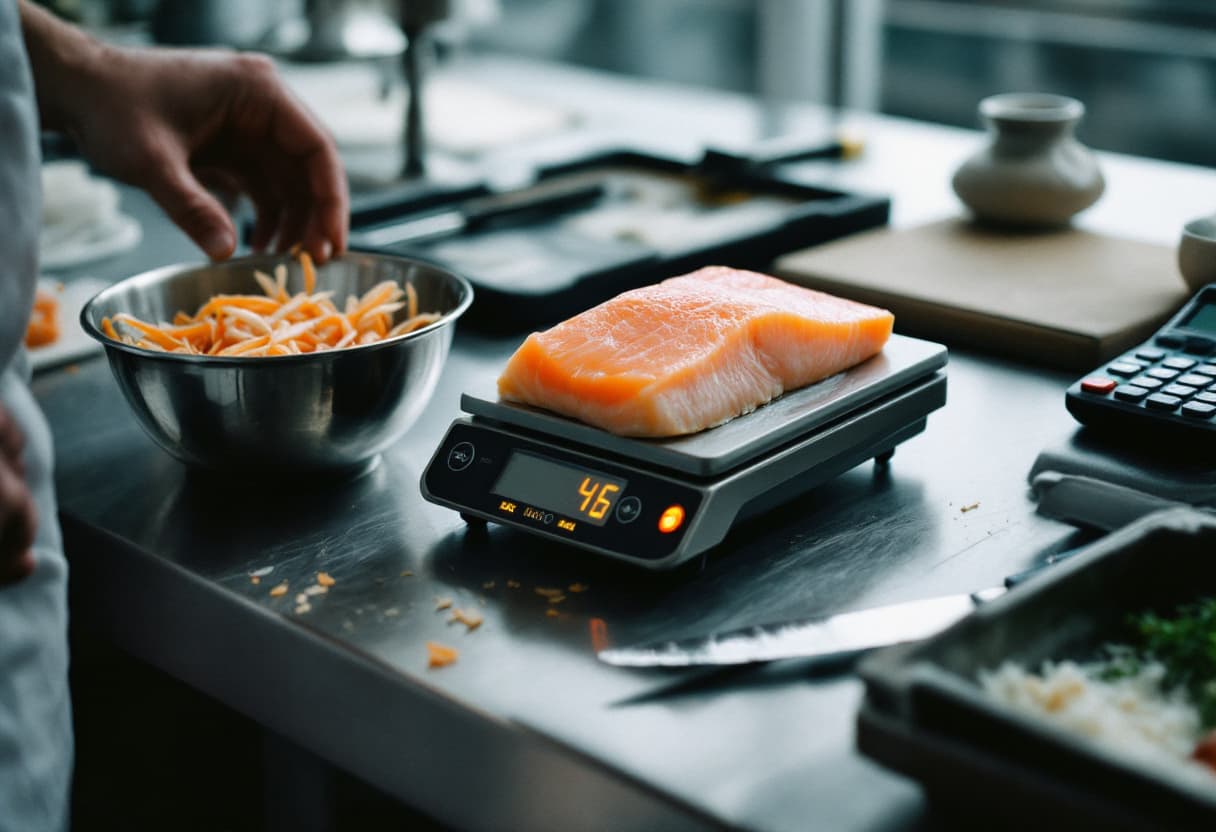
Twenty grams of extra cod on a fish and chips costs €0.42 a plate. At 120 plates a week that is €50, or about €2,640 a year, and nobody in the kitchen did anything wrong except reach for a slightly bigger piece. Portion control is the habit that stops this: every dish has a written portion, a tool that measures it and someone who checks it.
The portion is the bridge between the recipe card and the stock count. A card says the fish and chips costs €4.74 and runs at 32.6% food cost; the method behind that figure is in how to calculate food cost per dish, and the free food cost calculator has the same dish preloaded. The card is only true if the plate leaving the pass matches it. With the extra 20 g of cod the same dish runs at 35.5%.
What a portion spec contains
A portion spec is one line per component of the dish: what goes on the plate, how much, measured with what, and how far it may drift. For the fish and chips:
| Component | Portion | Measured by | Tolerance |
|---|---|---|---|
| Cod fillet | 180 g raw, skinned | scale, at prep | ±5 g |
| Chips | 300 g cooked | scale at the start of service, then by eye against a filled basket | ±30 g |
| Mushy peas | 80 g | #12 scoop (about 79 ml) | level scoop |
| Tartare sauce | 30 ml | 1 oz portion cup | full cup |
| Lemon | 1 wedge, 1/8 of a lemon | cut count | — |
Two columns do most of the work. Raw or cooked has to be stated, because a steak loses part of its weight on the grill and "200 g" means two different portions depending on when it is weighed. Spec proteins raw, at the point where they are cut. Tolerance turns the spec from a wish into a check: a cook who knows ±5 g is acceptable stops trimming fillets to the gram and starts noticing a 215 g one.
Add a photo of the plated dish. A photo fixes what the numbers cannot, such as where the sauce goes and how high the chips are piled, and it is what a new cook looks at on a Friday night.
Which items to police first
Not every component deserves a scale. Rank them by cost per gram multiplied by how many portions you sell, and control the top of the list.
| Over-portion | Extra per plate | Volume | Extra per year |
|---|---|---|---|
| Cod: 200 g instead of 180 g (85% yield, €18/kg) | €0.42 | 120 plates a week | about €2,640 |
| Mozzarella on a pizza: 150 g instead of 120 g (€7/kg) | €0.21 | 400 pizzas a week | about €4,370 |
| Chips: 360 g instead of 300 g (75% yield, €1.20/kg) | €0.10 | 120 plates a week | about €600 |
The mozzarella line surprises people. A cheap ingredient over-portioned on a high-volume item costs more than an expensive one on a dish that sells moderately. The chips line is the opposite case: a generous handful of chips is real money only in a chip shop doing several hundred portions a day. Everywhere else, policing chips costs more in attention than it saves.
A useful order for most menus: proteins, cheese, then whatever is bought in by the portion at a high unit price (prawns, scallops, burrata), then sauces made from butter or cream. Starches and vegetables come last.
Tools for each job
A digital scale with a tare button and 1 g resolution is the base tool. Put it where the portion is cut, not only at the pass. Weighing proteins at prep, then bagging or traying them by the portion, removes the decision from service altogether. This does not work for anything carved or sliced to order, such as a Sunday roast or a whole fish for two. There, spec a slice count and weigh a sample plate at the start of service.
Scoops (dishers) are numbered by how many level scoops fill a US quart, 946 ml. A #8 holds about 118 ml, a #12 about 79 ml, a #16 about 59 ml and a #30 about 32 ml. The higher the number, the smaller the scoop. Handles are often colour-coded by size, but the colours differ between makers, so write the number on the spec, not the colour.
Ladles and spoodles marked in ml or fl oz portion soups, sauces and dressings. A 90 ml ladle where the spec says 60 ml adds 50% to the sauce cost of every plate. Keep only the specced sizes at each station. Portion cups do the same for dips, and cake markers that score 12, 14 or 16 slices settle the most argued-about portion in a café.
The cheapest tool may be the supplier. Fillets or steaks cut to a specified weight cost more per kilo; compare that with the trim and over-portion you pay for now.
Measuring drift
Portion drift is slow and goes one way: portions grow. A dish sells well, the cooks get faster and more generous, and a few grams a week become 10% in a season.
Spot-weighing catches it. Once a week, weigh 10 portions of the 5 highest-cost items during normal service, without announcing it, and write down the average. A cod average of 196 g against a 180 g spec is 8.9% over. One heavy portion is noise. A heavy average is a habit.
The stock count catches what spot checks miss. Compare actual food cost for the period, from opening stock plus purchases minus closing stock, with the theoretical food cost from the recipe cards. A gap of more than two or three points comes from waste, over-portioning or stock leaving unrecorded, and the spot weights tell you which.
Plate waste is the signal in the other direction. WRAP's 2013 study of UK hospitality and food service found about a third of the sector's food waste coming back on guests' plates. Chips and garnish returning half-eaten mean the portion is bigger than guests want. That is a case for making it smaller, and is not the same as cutting portions to fix costs.
Portion control is not portion cutting
Shrinking portions to bring food cost down works for a few weeks. Regulars notice first, and they notice the plate before they notice the price. A dish that loses 10% of its main component to hold its price is a price rise that guests discover on their own, which is the worst way for them to discover it.
If a dish costs too much at the specced portion, the fix is on the price side or the recipe side: a different cut, a cheaper garnish, or a higher price worked out as in menu pricing. Prime cost puts it in the same order: cut the menu, not the portion. The exception is a portion that came back on the plate week after week. Then the guest has already voted, and a smaller portion is a better dish, not a cheaper one.
Measures the law fixes
Some portions are not yours to choose. In the UK, gin, rum, vodka and whisky sold by the glass must be served in 25 ml or 35 ml measures or multiples of them, and draught beer and cider in a third, a half, two-thirds of a pint or multiples of a half. The mandatory licensing conditions in England and Wales also require a 125 ml glass of wine, a half pint and a single measure of spirits to be available to anyone who asks. On these products portion control means a stamped thimble measure or a calibrated optic, and the variable is the pour, not the size. Costing drinks is a separate exercise, because pour cost targets run much lower than food.
A weight printed on the menu is a claim. An "8 oz sirloin" is read as 227 g raw, and a steak cut light to 190 g can be treated as a misleading description under UK consumer law, now in the Digital Markets, Competition and Consumers Act 2024. Calorie figures are claims too. Businesses in England with 250 or more employees have had to show kilocalories per portion since 6 April 2022 under the Calorie Labelling (Out of Home Sector) Regulations 2021, and US chains with 20 or more locations since 7 May 2018 under the FDA's menu labeling rule. A calorie figure is calculated for the specced portion. A scoop that drifted 30% larger makes the menu wrong.
Keeping specs in step with the menu
A spec goes stale when the menu changes and the folder does not. In the WMenu panel, each recipe card holds the net quantity per portion and the yield for every ingredient, with prices from one ingredient library, so changing a portion recosts the dish immediately and shows its new food cost against your target. That is part of the Standard plan, €29 a month (pricing). The panel does not weigh anything. The scale on the board and the weekly spot check stay in the kitchen.
Frequently asked questions
Should portions be weighed raw or cooked?
Proteins raw, at the moment they are cut, because that is the weight you pay for and the one a cook can control. Starches and anything portioned after cooking, such as rice, chips or braised meat, are specced cooked. Write which one on the spec every time.
How strict should the tolerance be?
Tight on expensive items and loose on cheap ones. ±5 g on a 180 g fillet is achievable with pre-cut portions; ±30 g on chips is realistic by eye. A tolerance nobody can meet in service gets ignored, and then there is no tolerance at all.